
This is an excerpt from Slipstream: A novel by Geoff W. Colmes.
They made it back just before sunset. Lila had Tito’s and soda waiting, a wedge of key lime in each glass when they came back up to the salon from their showers.
Cal pan-seared yellowtail fillets and set them on Carolina Gold rice, finished with lemon butter. On the side was a cucumber and tomato salad with slivers of onion, salt, pepper, and cider vinegar.
Lila opened a couple of bottles of Cloudy Bay Sauvignon Blanc.
“You’d be welcome anytime, Spence,” Eddie said. “You know this drill better than either of us. We’ll do it again, maybe with clients, but then again maybe not.”
“Yeah, well, it’s a whole lot easier when I’m not the one in charge.”
“I’m beginning to understand that part,” Cal said.
“As long as I get a proper shower and my own cabin, I’ll show up with a smile.”
“So, Spence,” Lila said. “I don’t know anything about you other than what Eddie has told me. Did you grow up in Islamorada?”
“Nope, I grew up in Coconut Grove.”
“Really?” Lila said.
“Yeah, well, that was back when the Grove was at least still the Grove.”
“I’m sure it’s changed,” Eddie said.
“It has changed. It was a different world back then, a different time, and we did a lot of stupid damn things that you’d never get away with these days.”
“Didn’t we all,” Cal said.
“Alright, then. Like what, stupid damn things, Spence?” Lila said.
Spence laughed.
“Like which time?”
“Okay, let’s hear it, doesn’t matter which one.”
“You want a short story or a long one?”
“Just a good one,” Lila said. “It’s not like we have anywhere to go, and it might even be better than one of Eddie’s fish stories or watching another movie.”
“Hey, come on, you know my fish stories are all true.”
“The jury’s still out on that, Kingie.”
“I won’t forget the Woodford this time,” Cal said.
“Now you’re talking,” Spence said. “You twisted my arm.”
“Who else is in?” Cal said.
“You need to ask?”
Cal crossed to the bar, poured three healthy rounds of Woodford, and handed the glasses over.
Spence settled deeper into the sofa and took a sip.
“Okay, you win. I think I’ve got a good one I can actually tell.
“So, it was around ’69, and if you were lucky enough to grow up there, it was a pretty special
place.
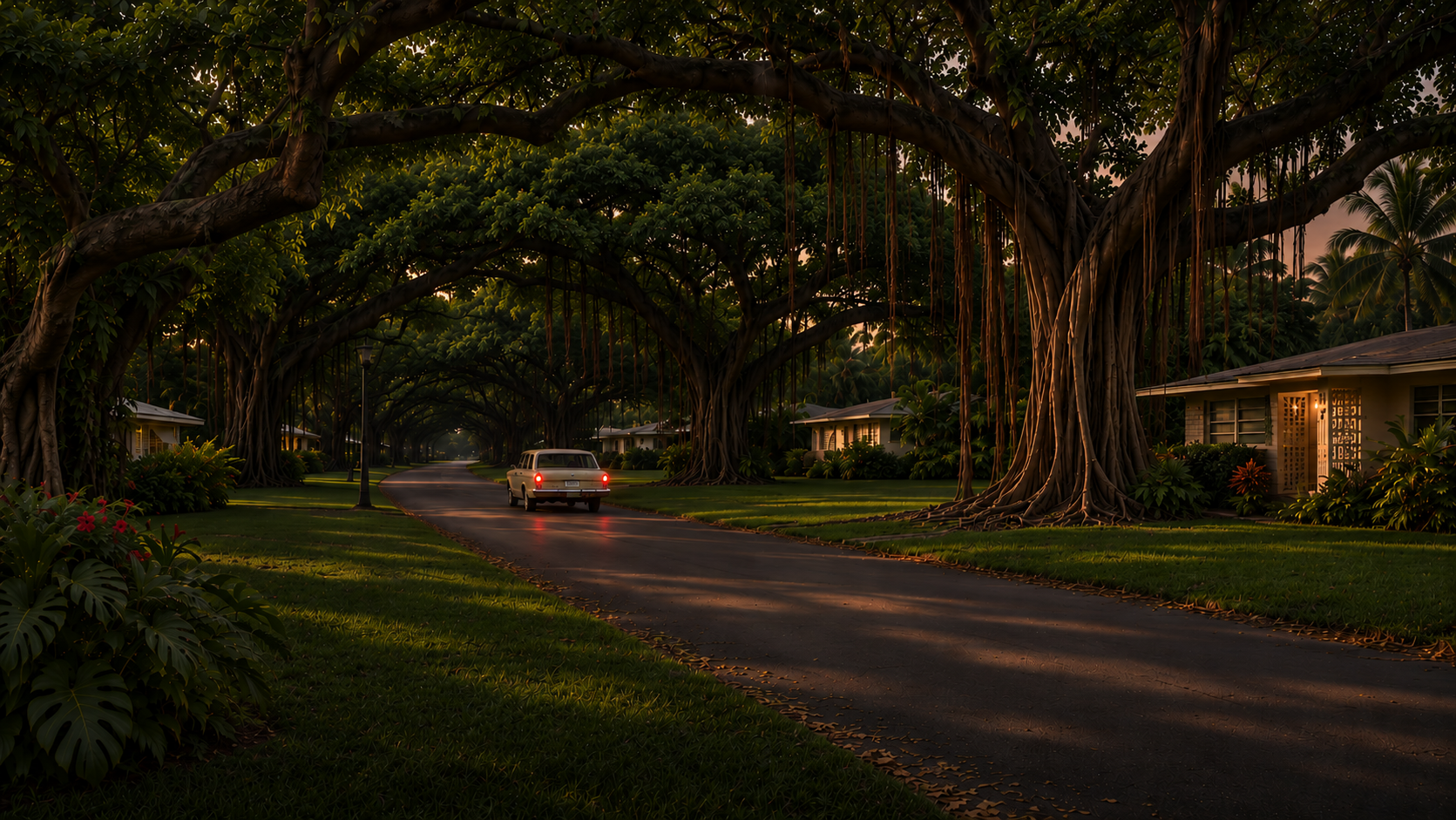
“We lived on Stewart Avenue. It was a quiet dead-end street with huge banyans and beautiful old houses on oversized lots. There was a canal out front where we kept our boats that led out to Biscayne Bay not too far from Dinner Key. We called it the Genie Bottle because of the round basin at the end.
“Hard to explain if you never saw it, but the neighborhoods felt darker then. Shadier. At least they did to us kids. I swear, I think it even rained more, the trees were thicker, greener, and there was hardly any damn traffic.
“That makes me want to drive up there and go see it,” Lila said.
“You can’t anymore, that is, unless you live there,” Spence said. “Stewart Avenue is private now, with a gate and security guard.
“The Vietnam War was all over the news back then. Nixon hadn’t been in the White House long, and every kid with an older brother worried about him getting drafted. And a lot of those older brothers enlisted so they could pick their branch of the service before it was chosen for them.”
“Boy, do I remember that,” Cal said.
Spence took a sip of his bourbon.
“Then there were the stories.”
“Okay, I give up,” Lila said. “What stories?”
“Those were the stories whispered between kids, especially the ones passed down from our older brothers. Back then they felt real, the way only legends can. On a nearby street called Leafy Way, we found one of those legends. Or at least, we thought we did.”
“Leafy Way?” Lila said. “This story is starting to sound real, Spence.”
Spence swirled his glass and took a sip of bourbon.
“You asked about the stupid damn things we did, right?”
“It all started with my older brother Mike and his best friend Scott. They spent summer evenings riding the Grove’s shadowy, quiet backroads in Scott’s purple Morris Minor convertible. One night they drove past a house on Leafy Way and something in the front window made them stop. A long, pale shape glowing behind drawn curtains.
“Whether Mike and Scott invented the story or inherited it, we didn’t care. It sounded real, way too real not to believe.”
“So, what was it?” Eddie said.
Spence smiled.
“Hold on, I’m getting to that. According to Mike and Scott, it was a coffin. The story was that the family who lived in that house had lost their son, a decorated war veteran. A few years after coming home from Vietnam, he took his own life. They said it was probably PTSD, though nobody called it that back then.
“They said, ‘They haven’t buried him yet. They’re keeping him in the house, and that’s his coffin in the living room behind the curtains.’
“We listened, and we believed them. We didn’t question our older brothers or their friends. They were our mentors, our idols, our gods. And so, we set out to see it for ourselves.
“We all piled in Ralph’s beige Ford Falcon station wagon. Ralph was a creeper. Twice as old as us, maybe thirty-something, and he always seemed eager to drive us around. He wanted to be called Raif. I guess that’s the Old English pronunciation, but he wasn’t a Brit and sure as hell didn’t attend Eton.”
“So, you got in the station wagon with that guy,” Cal said. “Could have been a narc, a pedo, or even worse.”
“If there is worse,” Eddie said. “Serial killer maybe?”
“Yeah, something about that guy felt off for sure, but he never gave us any reason to stop the free rides. After all, we were only teens. We didn’t care. Ralph had a car, and it was our ticket to freedom. We were invulnerable, you know, strength in numbers, and we looked out for each other. Hell, back then words like pedophile and serial killer weren’t exactly part of everyday conversation.”
He paused and smiled.
“Although we knew exactly what a narc was.”
“So anyway, we turned down Leafy Way, and we’d start chanting, ‘We’re off to see the coffin! We’re off to see the coffin!’ But it wasn’t just us anymore. The Grove was a small town back then, and the story spread like no-see-ums at dusk.
“Pretty soon it became a ritual. Just another Friday or Saturday night run. A couple of weeks later, more cars started showing up. On the weekends, that quiet, winding little lane became a procession of headlights creeping under the huge banyans.
“Each car carried a pack of kids, drinking, stoned, tripping. Car stereos blasting Hendrix, the Doors, Zeppelin, and the Airplane. All rolling toward the same place, staring at that window, hoping to see what shouldn’t be there.
“We kept going back, and every time we passed the house, it was still there behind the curtains. And it never changed.”
“You feel that, Cal?” Eddie said.
“She’s swinging on the hook. Tide’s just starting to fall.”
“Hold on, Spence, I don’t want to miss a word of this. I’m just going to head up top for a minute, make sure we’re not gonna drag, and check the proximity alarm.”
Cal stood and looked out the windows.
“Okay, while Eddie’s up there, who needs a refill?”
Spence and Lila raised their glasses.
Eddie came back down the stairs, poured another shot of bourbon, and sat back down. Lila shifted and settled in up against him.
“Okay, where was I?”
“That glow behind the curtains,” Lila said.
“Back then, the University of Miami campus was our playground. On weekend nights, you’d find neighborhood kids scattered around the lake by the Student Union or under the banyans. Nobody seemed to notice, and if they did, nobody cared.”
“I bet your parents didn’t care either,” Cal said.
“Exactly. If we told our parents we were headed to the campus, they were happy, figured it was the one place we couldn’t possibly get into trouble.
“Then one Saturday night, we piled in the Falcon and headed east on Sunset Drive.
“We passed my old elementary school, where I’d gone just a few years earlier. Around the traffic circle, over the Gables Waterway, up Ingraham Highway to Douglas, then Leafy Way.
“Taillights flickered through the trees, and we knew we weren’t alone, but that didn’t matter.
The chant started as we crept our way along. Ralph slowed the car while we looked out the windows, ready to see it again.
“And then the trees came alive.”
“Holy shit,” Eddie said.
“I think that’s exactly what I said, only louder. We never saw it coming. Turns out, the neighbors had finally had enough, especially the folks who lived in the house with the coffin. For months, they put up with the cars creeping by, the voices, the music, and the laughter. But that night, not all of them were inside.”
“So, they were waiting in the trees?” Lila said.
“Yep, all six of them.”
“Oh, crap.”
“Then we heard, THUMP, THUD, and before we could react, they dropped out of the trees. Big guys, bearded, in their twenties, looking like giants to our scrawny band of long-haired teens, and of course, Ralph, who fit in like a screen door on a submarine.
“They were fast, quiet, looked seriously pissed off, and oddly enough, all wearing raccoon skin hats. Then came the chaos. Car doors flew open and huge hands grabbed us, yanking us out of the Falcon wagon like rag dolls. The traffic was stopped behind us.”
“Then one guy shouted, ‘You wanna fuckin’ see it? Fine. Let’s go.’
“One second, we were watching from the safety of the Falcon, and the next, we were part of the story. It was mayhem.”
“Then what’d you guys do?” Lila said.
“Then… BOOM. Another. Gunshots. Loud.”
Lila and Eddie flinched.
“Then there were flashes in the dark. They could have been warning shots meant for the other cars behind us, but we didn’t know. Then tires screeched, kids screamed, and the whole slow-rolling funeral procession thing turned into a damn fire drill.”
“But us? We were still there, detained, captured by a giant bearded dude who looked like Davy Crockett, with his badass posse alongside.
“Then something clicked, and I realized I knew that face. It was one of the Stern brothers. Mike Stern, and now he was looking at us, narrowing his eyes.”
“So, you knew them?”
“Just one of them, Cal. And that’s when it hit me. A few years earlier, my parents were selling our place in nearby Sunrise Harbor and house-hunting in the Grove.
“Mom was a realtor and happened to meet the Sterns at her office. They were looking for a home in Sunrise Harbor and living on Stewart in the Grove. A house swap worked for everyone, and that’s how I knew Mike.
“So, Mike, as it happened, was over at a friend’s place on Leafy Way that evening, helping to solve some neighborhood traffic problems. If fixer had been a job title back then, he would’ve had it printed on a business card.
“I didn’t recognize him right away, with that coonskin hat on, but then it hit me. Here I was, standing in the middle of Leafy Way, looking at the guy who lived in our old house while we were living in his.”
“Did Mike give you guys a break?” Eddie said.
“Not much of one, but we figured we probably weren’t going to die after all. We knew better than to put up a fight. We were too stunned, too freaked out to do anything but shuffle along.
“Oh my god, and what about Raif?”
“He didn’t say a word, and I remember he was shaking like a leaf when they marched us from the open garage, through the kitchen, and to the living room, where the homeowners were waiting.”
“Holy shit,” Eddie said.
“Exactly, holy shit once again.”
“I’ll never forget the owner standing there with his wife, flanked by six giant dudes, and saying, ‘Look real close, you little hippies.’”
“So, I’m guessing it wasn’t a coffin,” Lila said.
“Nope, and not a beloved son who was a war hero waiting for burial.
“Just a huge rectangular illuminated saltwater fish tank. The shape that never moved. And inside, swimming around without a care, were a couple of damn clownfish. That’s when one of the Grove’s greatest urban legends died right before our eyes.”
“Wow,” Lila said. “Did they let you guys go then?”
“Yeah, Mike and his Merry Men eventually showed us some mercy and released us, ordering us to spread the word that there was no coffin. Still stunned, we climbed back in the Falcon.
“Nobody said a word on the drive back, especially Ralph. He was shaking so hard I thought he might run off the road and kill us.
“So, the ritual was dead, and Leafy Way went back to being just another quiet neighborhood. No more creeping down the street. No more chanting, and no more coffin.
“What happened to the creeper, Ralph or Raif?” Cal said.
“Funny you ask. After dropping us off at nearby Merrie Christmas Park, he drove off like a man fleeing a crime scene. I think those guys scared him even worse than they scared us, and that’s saying something.
“And we never saw him again. Maybe he left town, maybe he found another bunch of kids to drive around. Who knows? Come to think of it, he always seemed to find us, but we weren’t exactly looking for him.”
“Have you ever been back?” Lila said.
“Yeah, once, but it was years ago. Like my old neighborhood on Stewart, Leafy Way’s gated now with a security guard.
“Today some of those same properties are selling for over ten million, only to have the houses torn down and replaced.”
“You must really miss that place, Spence.”
“Yeah, Lila, if I had a time machine and could go back, I wouldn’t change a thing.
“The hippies, head shops, concerts, Hare Krishnas, VW vans, even Lum’s.
“Lum’s?”
“Hell, there were Lum’s restaurants all over South Florida back then, but the one in the Grove was something else. Right across from Peacock Park. It was kind of a family restaurant, but you had locals, hippies, all kinds of characters hanging around. Half the folks in there were stoned, and the other half were probably tripping. Nobody was in much of a hurry. That was the old Grove.
“Eventually, all that disappeared, except maybe the sailing club. But at least back then, kids like us could still roam around. Legends could still take root, and the neighborhoods still had a little wildness, a little mystery.”
“No more kids driving around looking for a coffin these days,” Cal said.
“Yep, pretty much, and sadly, a different place.”
*
Cal was stretched out on the sofa, asleep. Lila gently took the empty glass from his hand.
“Night, you guys, I’m beat and going to bed. Just gonna leave Cal right where he is.”
She went below, came back with a pillow and blanket, slipped the pillow under his head, and covered him with the blanket.
“Thanks, kid,” he mumbled.
She dimmed the salon lights.
Eddie and Spence poured another drink and went up to the bridge. They sat for a while longer, talking quietly while Slipstream rode steady on the anchor in the current.
Eddie walked up to the helm and turned on the forward sonar.
“Spence, you gotta see this. Check out the live scope.”
“What the hell are those things? They’re huge.”
Spence stared at the screen for a moment.
“Could be big tarpon, maybe big bulls or even nurse sharks. They’re not bulky enough to be goliaths, though.”
“Not sure I want to know,” Eddie said.
“You know, I used to lie awake out here at night wondering what was swimming under the boat. These rivers are deep in places, and there’s a whole world down there you’ll never see. Back then all I could do was imagine it.”
“Kinda spooky to actually see it. Not much left for imagination these days.”